Before the blockchain. Before Bitcoin. Before Satoshi Nakamoto published a nine-page white paper describing a peer-to-peer electronic cash system — 87 years before, to be precise — Henry Ford had the same idea.
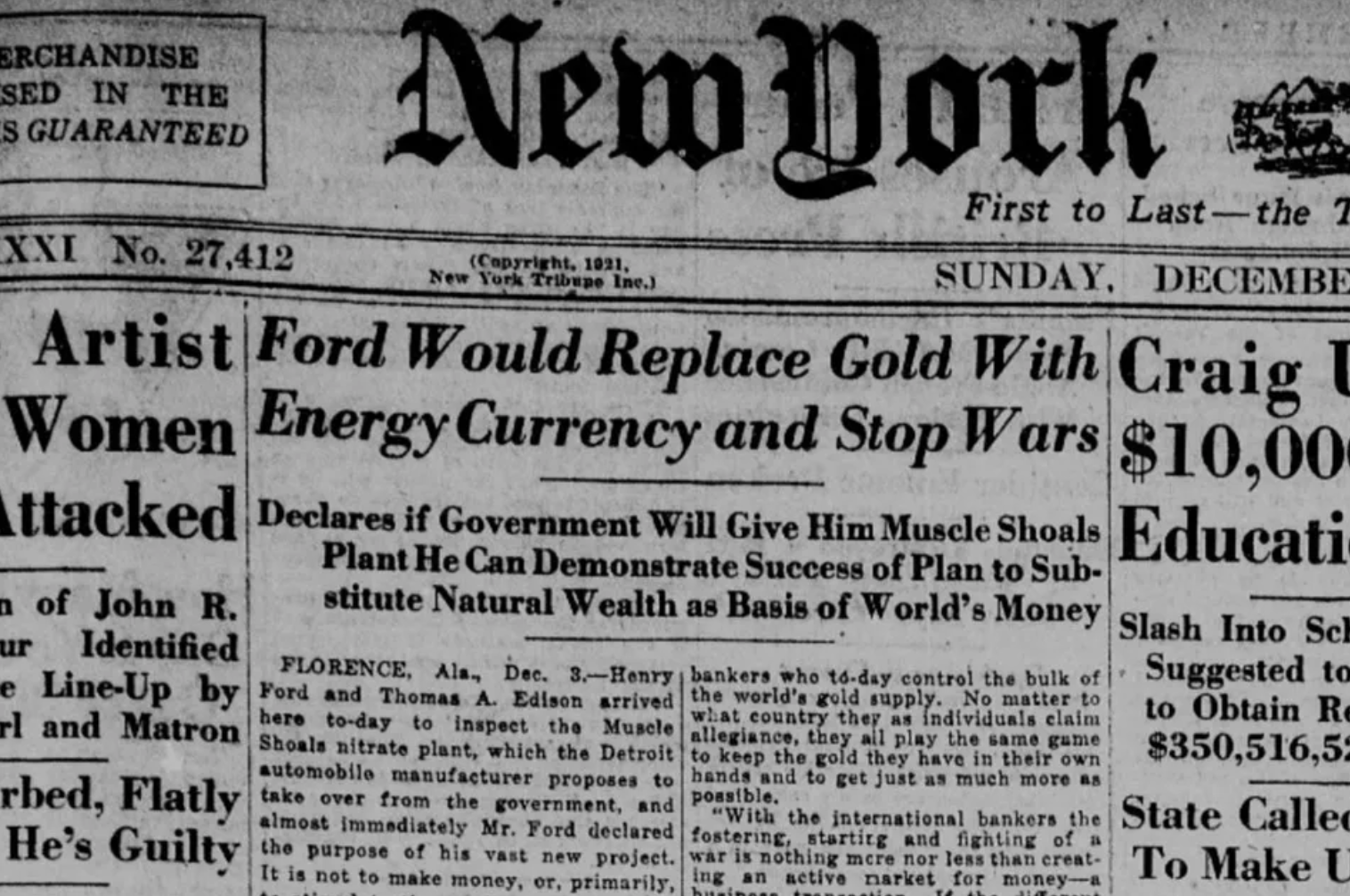
On December 4, 1921, the New York Tribune ran a front-page article headlined: "Ford Would Replace Gold With Energy Currency And Stop Wars." The story detailed Ford's proposal to build the world's greatest hydroelectric power plant at Muscle Shoals on the Tennessee River and issue a new currency backed not by gold locked in a vault, but by units of energy — kilowatt-hours produced and verified at the source.
The idea was not naive. It was precise. And it has taken a century for the infrastructure to arrive that could finally build what Ford described.
What Ford Actually Said
Ford's critique was not primarily economic. It was political. His argument was that gold's most dangerous property was not its scarcity or its weight — it was its controllability. A sufficiently powerful group could corner the gold supply, and through gold, control the currencies of nations, and through currencies, fund and extend wars that the people of those nations would never have chosen.
His solution was not abstract. He told the Tribune exactly what the new system would look like: "Under the energy currency system the standard would be a certain amount of energy exerted for one hour that would be equal to one dollar." Currency pegged to the kilowatt-hour. Issued only to a specific amount and for a specific purpose — scarcity built in by physical reality rather than by a central bank's discretion. And immune, in theory, to the kind of concentrated control that gold enabled, because energy is produced everywhere, by rivers and wind and sun, and cannot be accumulated in a single vault by a single institution.
He also told the Tribune what he intended to break: "It's simply a case of thinking and calculating in terms different from those laid down to us by the international banking group to which we have grown so accustomed that we think there is no other desirable standard."
Ford's energy currency was not a proposal to make power cheaper. It was a proposal to make power free — free from the concentrated control that made it a tool of domination rather than a medium of exchange. The distinction matters now as much as it did in 1921.
Why It Could Not Be Built Then
Ford's vision failed not because it was wrong but because the infrastructure it required did not exist. Three problems were unsolvable in 1921:
Verification. How do you prove that a specific quantity of energy was produced at a specific place and time, in a way that cannot be falsified? Ford's plan centered on Muscle Shoals Dam as the single source — which solved the verification problem by making it a controlled, centralized facility. But a currency backed by energy from a single dam is not fundamentally different from a currency backed by gold in a single vault. The virtue of energy currency — that it could be produced everywhere — was also its problem. You could not verify distributed production with 1921 technology.
Transfer. How do you move a unit of energy currency from Tennessee to London to Tokyo without a centralized clearing system? The existing clearing infrastructure was precisely the banking system Ford was trying to displace. He had no alternative settlement layer.
Issuance control. Ford specified the currency should be "issued only to a certain definite amount and for a specific purpose" — a hard cap, algorithmically enforced. In 1921, the only mechanism for enforcing monetary supply limits was institutional trust. The institution that issued the currency could always issue more. Ford needed a trustless system with cryptographic enforcement of its own rules. That system did not exist.
He had the philosophy exactly right. He was 87 years early.
What Blockchain Solves — Energy as a Real-World Asset
Each of Ford's three unsolvable problems has now been solved:
- Verification → blockchain oracles: Smart meters connected to blockchain oracles can record energy production at the kilowatt-hour level, tied to GPS coordinates and timestamps, in a tamper-proof ledger. A solar panel in Arizona, a wind turbine in Denmark, a hydroelectric generator in Kenya — each unit of production can be recorded, verified by independent nodes, and made publicly auditable without central authority. This is exactly the oracle infrastructure already built for price feeds, rainfall data, and property valuations. Energy production is the same problem, already solved for other asset classes.
- Transfer → public blockchain settlement: A tokenized energy unit on a public blockchain can transfer from a producer in Tennessee to a buyer in Tokyo in seconds, without a correspondent bank, a clearing house, or the banking infrastructure Ford specifically identified as the problem. The settlement layer is the network itself — maintained by distributed node operators with no single point of control.
- Enforced scarcity → cryptographic supply caps: Bitcoin proved that a hard supply cap — Ford's "issued only to a certain definite amount" — can be enforced by mathematics rather than institutional trust. The same principle applies to tokenized energy certificates: issuance is tied to verified production, not to the discretion of whoever controls the mint.
Energy is now a real-world asset in every meaningful sense: it exists at specific coordinates, can be measured and verified by independent instruments, can be recorded on an immutable ledger, and can be transferred globally without intermediary permission. The infrastructure Ford needed was blockchain. Blockchain did not exist until 2009.
The Point Was Never Cheap Power
There is a tendency to frame energy tokenization as a cost story: cheaper electricity, more efficient grid management, reduced transmission losses. These are real benefits. They are not Ford's point. His critique was about control — gold's most dangerous property was not its scarcity, it was its controllability. The same principle applies to energy currency: its virtue is not that kilowatt-hours are cheap, but that they cannot be monopolized by a single institution. Energy is produced everywhere, and a currency backed by distributed energy production cannot be cornered in a vault the way gold can.
The Demand That Makes This Urgent
The AI data center boom is accelerating the case for distributed, tokenized energy beyond the philosophical. Demand is growing from 31 gigawatts toward 66 gigawatts by 2027. Centralized grid infrastructure cannot scale fast enough to serve that demand without massive capital investment in transmission and generation that takes years to permit and build.
Distributed production — solar, wind, and hydroelectric generation at the community and facility level — connected through blockchain-based settlement to buyers who need reliable baseload power — is the only architecture that scales without rebuilding the physical grid from scratch. Ford's instinct at Muscle Shoals was precisely this: build the power where the natural resources are, verify what was produced, and issue currency against that production. The Tennessee River was his distributed generation asset. The digital grid is the blockchain settlement layer he needed and did not have.
The Idea Is 100 Years Old. The Infrastructure Just Arrived.
The history of technology is full of ideas that arrived before their infrastructure. Ford's assembly line needed steel and rubber supply chains that barely existed when he started. The internet needed fiber optic cable, packet switching, and browser software that took decades to develop after the theoretical foundations were laid.
Ford's energy currency needed a distributed, trustless, cryptographically enforced ledger — and it needed smart meter technology capable of verified production measurement at the kilowatt-hour level — and it needed a global settlement network that required no trusted intermediary. It needed, in short, everything that blockchain infrastructure has built between 2009 and 2026.
Tokenized renewable energy certificates are trading on Ethereum. Peer-to-peer energy markets are live in Australia, Europe, and parts of Asia. Power purchase agreements are being tokenized as RWAs for institutional investors. The verification layer connecting physical energy production to on-chain records is being standardized by the same protocols that now serve $40 billion in tokenized financial assets.
Ford looked at the Tennessee River in 1921 and saw not just hydroelectric power but a new monetary system. He was right about what energy could become. He was wrong only about how long it would take.
The technology finally caught up. The idea is 100 years old. The infrastructure just arrived.
GREEN is a blockchain project working to bring the energy-as-currency concept Ford described into practical infrastructure — building toward a future where energy producers can tokenize and transact directly with buyers, without centralized intermediaries controlling the flow of value that flows from natural resources.
Ford had the idea. The technology now exists to build it. GREEN is among the projects trying to do exactly that.
→ AI Data Centers and the Power Grid — the demand that makes this urgent
→ What Is Tokenization? — the infrastructure Ford needed but didn't have
→ Element United — natural resource sovereignty on-chain